
Gas City and Factory.ai belong in the same comparison. Both are software-factory platforms for turning engineering methods into repeatable agent work across the software lifecycle.
The practical difference is ownership versus integration. Gas City is a free, MIT-licensed engine that runs customer-owned packs with interchangeable coding agents and Beads as durable work. Factory.ai is a paid commercial platform that integrates its Droids, Missions, persistent computers, model access, telemetry, and enterprise controls. Which design fits depends on what the team wants to operate itself and what it wants a vendor to provide.
Gas City, Inc. publishes this comparison and is the company behind Gas City. The page was reviewed against official Factory.ai and Gas City sources on August 1, 2026. Factory.ai changes quickly, so the linked product pages are part of the comparison.
This is a factory-to-factory decision
Factory.ai describes the software factory as an end-to-end, agent-native system that turns outside signals into planned, built, tested, reviewed, secured, shipped, and monitored changes. Its current product spans interactive Droids, headless execution, multi-agent Missions, model routing, persistent computers, analytics, and enterprise deployment.
Gas City uses the term more structurally. A factory combines durable work, coding-agent workers, workflows, automations, reusable knowledge, repository isolation, and an orchestration engine. Gas City supplies that engine and the configuration model; packs carry the factory’s agents, workflows, automations, prompts, skills, and supporting files.
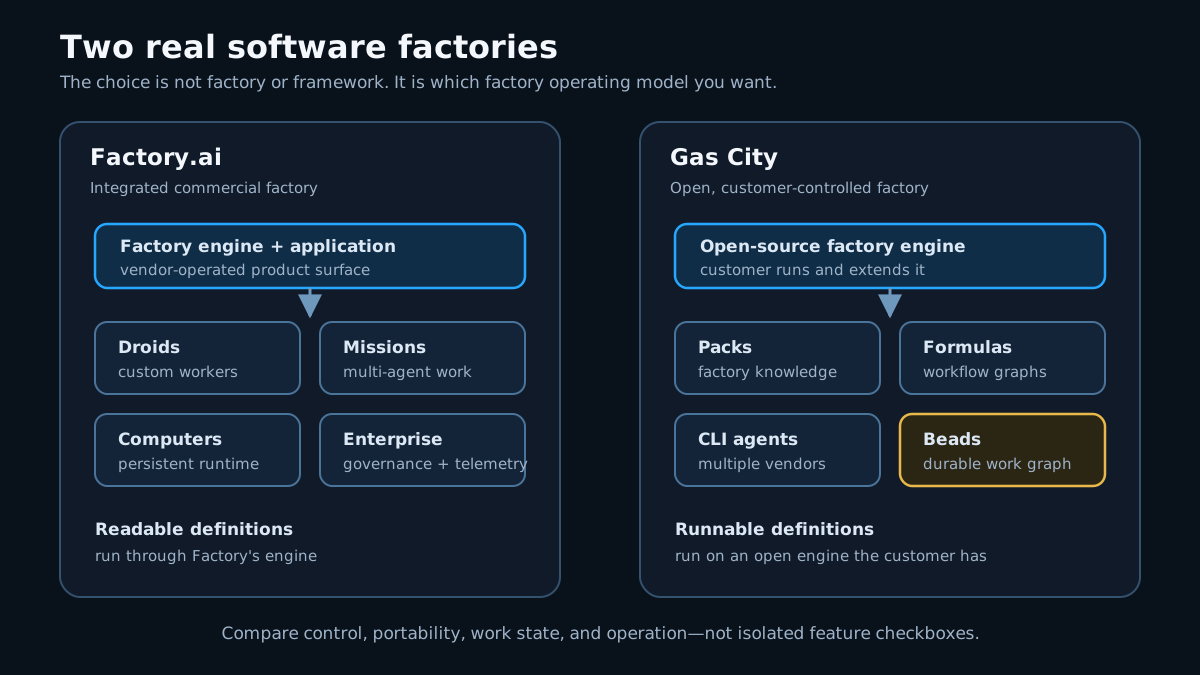
Neither side is merely a chat interface or a library. Both intend to operate continuing software production.
Compare the operating models
The same criteria expose the products’ different boundaries.
| Factory criterion | Gas City | Factory.ai |
|---|---|---|
| Engine and license | Free, MIT-licensed engine the team can inspect, run, and extend | Paid commercial platform operated through Factory.ai’s product and deployment surfaces |
| Coding-agent choice | Configures Claude Code, Codex, Gemini CLI, OpenCode, or custom harnesses as workers | Centers Factory Droids while supporting multiple models, provider keys, open-source models, and local endpoints |
| Durable work | Beads keeps identity, hierarchy, blockers, assignment, provenance, and history outside worker sessions | Missions, persistent computers, sessions, and platform telemetry preserve continuing work |
| Factory method | Packs carry agents, workflows, automations, prompts, skills, and supporting files as inspectable configuration | AGENTS.md files, skills, custom Droids, settings, and Missions configure the Factory.ai environment |
| Extension and distribution | Packs can be inspected, forked, published, and installed through an open registry | Factory.ai supplies an integrated product, documentation, enterprise controls, and vendor support |
| Compute and deployment | Runs coding-agent CLIs in environments the operator supplies | Offers registered machines, managed persistent cloud computers, and documented cloud, hybrid, and air-gapped deployment options |
Gas City: an open engine and portable method
Gas City starts with agents the operator already uses. A factory can route one step to Claude Code, another to Codex, another to Gemini CLI, and a custom harness somewhere else. The workflow remains a Gas City workflow rather than becoming an implementation detail of one agent vendor.
A formula materializes a workflow as beads with explicit dependencies. Beads preserves assignment, status, hierarchy, blockers, provenance, and history outside any coding-agent session. The orchestrator advances the ready frontier even as workers come and go.
The factory itself is portable configuration. A pack can bundle the roles a team wants, the workflows they follow, the automations that trigger them, and the knowledge agents need. The public Registry gives that configuration a distribution path. A team can install a community pack, inspect it, fork it, or publish its own.
This structure matters when factory engineering becomes part of the team’s craft. The investment accrues in artifacts the team can read and run on an open engine.
Open configuration runs on an open engine
Factory.ai exposes substantial configuration. AGENTS.md files, skills, custom Droids, settings, and Missions are real, readable ways to shape its behavior. The distinction is not that one platform has configuration and the other hides it.
The structural distinction is where that configuration runs. Factory definitions run through Factory’s engine and product surfaces. Gas City packs and formulas run through an open-source engine the customer has. That affects how deeply a team can inspect behavior, build tooling around it, carry the factory into its own environment, and share extensions without waiting for a platform surface.
Factory configuration remains useful inside Factory.ai. Gas City configuration remains available with the open engine that runs it. That gives teams different ownership and portability boundaries.
Durable work has a different center
Factory.ai keeps long-running agent work alive through product sessions, persistent computers, Missions, and platform telemetry. Droid Computers can preserve installed tools, files, services, and configuration across sessions. Factory’s enterprise platform adds organization-level observation and control.
Gas City centers the durable record on Beads. A bead exists independently of the worker that acts on it. When an agent crashes, a replacement can inspect the same work, see its relationships and history, and continue. A graph-workflow run is materialized as root and step beads; Gas City’s local dashboard and API project the run from retained bead lifecycle events and enrich it with live execution detail.
For shared organizational retention, the Beads Team Server preview captures those records into a shared location with an organization-selected retention period. Gasworks is the team version of Gas City: multiple operators running and improving one shared factory configuration.
Factory.ai: an integrated commercial operation
Factory’s current documentation presents a broad working surface: Droid in the terminal and desktop app, Droid Exec for automation, Missions for structured multi-agent projects, persistent Droid Computers, local and automated code review, custom Droids, skills, MCP, and enterprise controls. That integration reduces assembly work.
Factory.ai joins its application, CLI, Missions, managed or customer-supplied computers, usage views, model access, and enterprise administration in one paid commercial product. It also supports provider keys, open-source models, and local endpoints; it is not a single-model system.
Factory.ai documents cloud-managed, hybrid, fully air-gapped, hierarchical-control, audit, compliance, and OTEL-native deployment options. Droid Computers provide registered machines and managed persistent cloud computers as one native surface. Gas City does not currently offer an equivalent managed-computer experience in the OSS product.
Those capabilities reduce the amount a team has to assemble and operate itself. The corresponding tradeoff is that its factory definitions execute through Factory.ai’s commercial engine and product surfaces.
Decide from the operating requirements
Gas City supplies a free open-source engine, interchangeable CLI-agent workers, Beads-backed work, customer-owned packs, and an open distribution path. A team operating it is also responsible for supplying and maintaining the surrounding compute and deployment environment.
Factory.ai supplies an integrated paid product with Droids, Missions, persistent computers, model access, usage views, enterprise administration, and vendor support. Its configuration is readable and substantial, but it runs through Factory.ai’s engine.
The decision turns on the team’s requirements for engine ownership, worker neutrality, portable configuration, managed compute, enterprise deployment, vendor support, and price.
Run the same representative job through both. Include a worker interruption, a parallel review, a workflow change, a model change, and a second repository. Then inspect where the work state lives, which parts of the method you can carry away, and how much of the resulting factory your team actually owns.
Related articles
- Build an AI software factory: Start with the category and the operating loop before choosing a platform.
- Gas City vs 8090 Software Factory: Compare an open execution-centered factory with a collaborative requirements-to-code control plane.
- Software factories vs agent frameworks: Separate factory products from libraries used to build agent applications.
- Agent orchestration evaluation rubric: Test factory candidates with the same work, interruption, and evidence standard.