
Task management for coding agents is durable work state the agent can query, update, relate, and resume on its own. A list of tasks is enough for an afternoon. It starts to fail when the work outlives one context window.
The label “agentic task management” now covers several different products: chat-session todos, AI planning tools, human issue trackers with APIs, and durable work graphs. They serve different jobs. Before comparing brands, determine which job you need done.

Six questions that expose the difference
Can the agent operate it directly?
An agent-native system has a command line or equally direct structured interface. The agent can create work, inspect it, update status, and record discoveries without asking a person to translate every action through a graphical interface.
“Has an API” is a weak test. Many human trackers have APIs, but their model, authentication, workflows, and response shapes were built around organizational reporting. Direct agent use should be the ordinary path.
Look for machine-readable output, stable IDs, useful errors, and a workflow compact enough to remain in the agent’s operating instructions.
Does work survive the session?
Session todos are useful scratch space. They disappear, compress badly, or lose their meaning when another agent takes over.
Durable work lives outside the conversation. After a restart, the agent should recover the job definition, current status, material notes, and the next action without replaying the chat. That is the baseline for long-running work, not an enterprise add-on.
Durable memory for coding agents explains exactly which state must survive.
Can it express hierarchy and blocking?
Software work has structure. A feature contains tasks. One migration blocks an API change. A bug discovered during implementation belongs to that chain of evidence even when it does not block the original work.
A title, checkbox, and free-form description cannot reliably carry all of those meanings. Typed edges can. Parent/child, blocks, and discovered-from relationships let the agent query structure instead of interpreting prose again on every turn.
Can it answer what is ready?
“What should I do next?” should be a query, not a fresh planning exercise.
A strong system computes the open work with no active blocker and excludes work already in progress, deferred, or held at a gate. That answer is the ready frontier. As agents close blockers, the frontier changes automatically.
This is the practical payoff of an agent work graph: plans stay responsive without being regenerated.
Can multiple agents claim safely?
Two agents reading the same open item and both starting it is not coordination. It is a race.
Multi-agent task management needs an atomic claim: one operation that succeeds for a single agent and makes the new state visible to the others. It also needs IDs and writes that tolerate concurrent creation. File formats designed around a single human editor usually need an additional coordination layer before they can promise that.
Is the work independent of one agent vendor?
Your task history should not be collateral damage when you switch models, CLIs, or editors.
Vendor neutrality means the durable work model remains available through ordinary, inspectable tools. Claude Code can record a discovery today; Codex or Gemini CLI can act on it tomorrow. The agent changes. The graph does not.
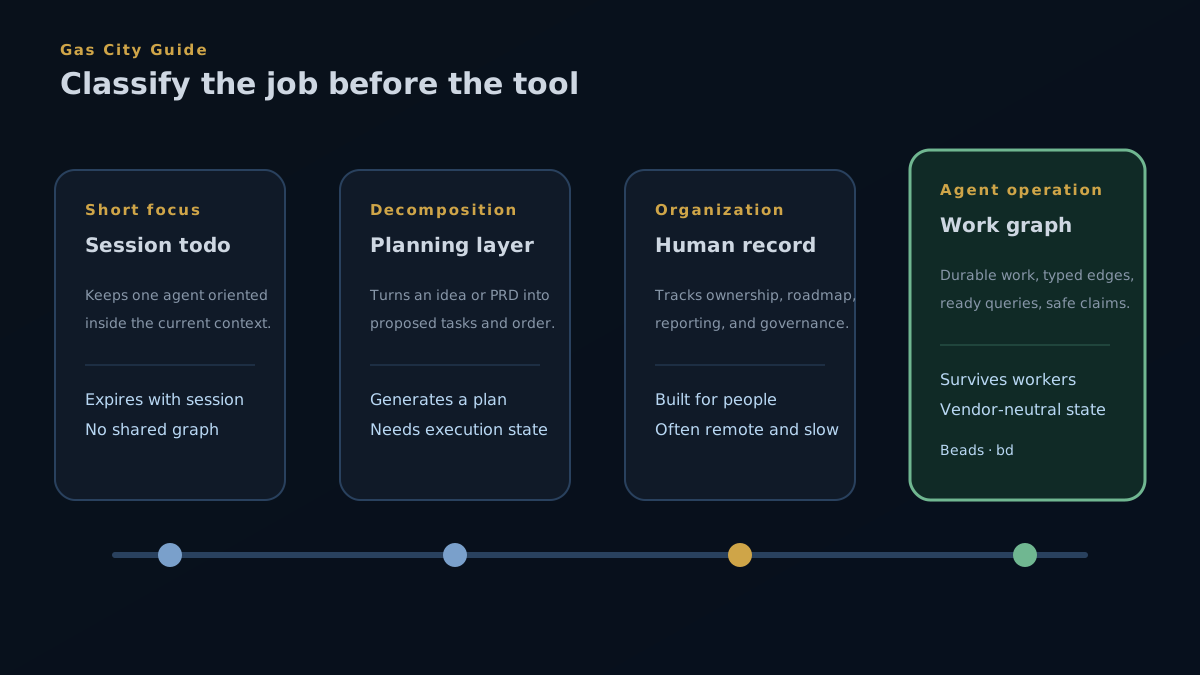
Four tools that people call task managers
These categories overlap, but each has a natural center.
| Approach | Job it does well | Where it runs out |
|---|---|---|
| Session todo | Keeps the current agent focused for a short job | Session loss, weak handoff, no shared graph |
| Planning layer | Turns a prompt or PRD into a proposed task breakdown | Planning output still needs durable coordination |
| Human system of record | Gives teams ownership, reporting, roadmaps, and governance | Agent latency and ergonomics; limited local work state |
| Agent work graph | Gives agents durable, queryable, connected work and safe claims | Team governance may require a separate server or organizational tracker |
None of these is inherently illegitimate. A six-line Markdown checklist can be the right tool for a six-line change. Jira can remain the right place for portfolio commitments. The mistake is asking one category to perform another category’s job without checking the seams. The Beads integration guide for Jira, Linear, and GitHub Issues defines that system-of-action/system-of-record seam for teams that need both layers.
For example, a planning tool can propose a very good task tree while offering little protection against concurrent agents or a crashed session. A human tracker can preserve a ticket for years while making every agent interaction slow and organization-specific. The durable agent layer belongs close to the code and the agent’s normal command loop.
Where Beads fits
Beads is the open protocol for durable agent work. It stores a vendor-neutral work graph in Dolt and gives agents a compact CLI for querying ready work, claiming it, recording discoveries, and closing it.
Against the six questions:
- Agents operate Beads directly through
bdand structured JSON output. - Work survives sessions in a version-controlled database.
- Typed relationships express hierarchy, blocking, provenance, and other links.
bd readycomputes the claimable frontier.- Atomic claiming and hash-based IDs support safe parallel work.
- Integration recipes cover multiple coding-agent vendors and editors.
For Beads adoption, architecture, and product details, continue to the Beads Guide. If you are evaluating named products, use the agent work management comparison after you have decided which category you actually need.
A quick evaluation you can run
Give each candidate one realistic feature with three pieces of work:
- a schema change;
- an endpoint blocked by that schema;
- documentation that can run in parallel.
Then introduce a bug discovered during the endpoint work. Have two agents ask for ready work at once. End one session mid-task and start a replacement.
Watch what happens:
- Does the blocker remain explicit?
- Can the discovery keep its provenance?
- Do the agents avoid claiming the same task?
- Can the replacement recover status and notes?
- Can another coding-agent vendor read the same state?
A half-hour exercise like this will expose the seams that a long feature grid hides.
Run it before choosing a product name. The result should tell you whether you need a short-lived checklist, a planning layer, an organizational tracker, or a durable work graph.
Related articles
- Beads: See how the category criteria come together in one open product.
- Top agent work management systems compared: Compare direct alternatives after identifying the job.
- Durable memory for coding agents: Go deeper on the state that must survive a session.
- Why coding agents need a work graph: Learn how hierarchy, blockers, provenance, and readiness work.