
Two open-source products anchor the current ecosystem. Beads stores durable agent work. Gas City runs a customer-owned software factory on that work. Beads Team Server and Gasworks extend the path for teams, while the Registry, documentation, GitHub projects, and Discord make the open ecosystem useful in practice.
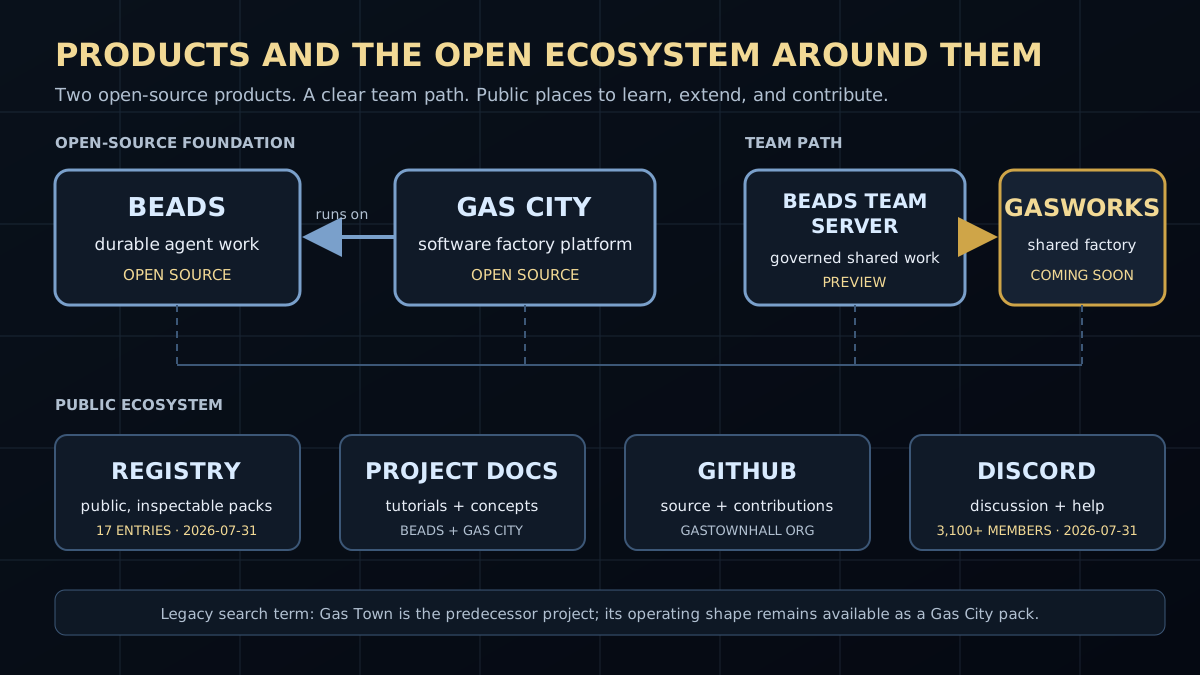
The four product names
| Product | Job | Availability |
|---|---|---|
| Beads | The open protocol and open-source substrate for durable agent work | Open source |
| Gas City | The open software factory platform that runs on Beads | Open source |
| Beads Team Server | Shares and governs team beads; in preview, captures organizational Runs with organization-chosen retention | Preview through design partnerships |
| Gasworks | The team, multi-operator version of the factory path; includes Beads Team Server | Coming soon |
The shortest useful distinction is work versus factory. Beads gives agents durable, vendor-neutral work with graph relationships. Gas City supplies the configured agents, workflows, automations, prompts, skills, and packs that operate on it.
The Beads Guide goes deeper on durable work. Build an AI software factory explains the system Gas City runs.
The open-source foundation
Beads
Beads is the open protocol and open-source substrate for durable agent work. Its parent-child and blocking relationships give coding agents a work graph that survives chat compaction, process crashes, and handoffs. Beads works on its own; Gas City uses it as the independent work layer beneath orchestration.
The maintained tutorial, concepts, and CLI reference live at beads.gascity.com.
Gas City
Gas City is the MIT-licensed open software factory platform that runs on Beads. It orchestrates CLI coding agents through customer-owned packs and formulas, keeps the work in Beads, and derives local operating views from data already on the developer’s machine.
Agent roles and formula workflows come from the packs you import. The public gascity pack is the same working method the team uses to maintain Beads, Gas City, and the public repository fleet in the gastownhall GitHub organization.
Maintained product documentation lives at docs.gascity.com. The factory-in-practice article connects the public pack to dated operating results.
The team path
The team path starts when durable work must cross people and machines. Beads Team Server adds governed shared work; Gasworks adds one factory that several operators can run and improve. The portfolio guide covers availability, placement, retention, and selection details for both products.
Registry turns configuration into an ecosystem
The Gas City Registry is the public catalog for reusable factory packs. A pack may supply a complete build method, one review discipline, a coding-agent role, a service adapter, or a runtime extension.
On August 7, 2026, the live Registry catalog listed 17 packs: 16 maintained entries and one community entry. It included the first-party Gas City factory; BMAD, Compound Engineering, gstack, and Superpowers build methods; contribution and pull-request workflows; GitHub, Discord, and Slack adapters; and a Cloudflare runtime extension.
That range matters more than the count. It shows that the extension model can carry methodology, integration, and runtime choices without putting them all in the Gas City binary. Each listing exposes a pinned source that a developer can inspect before importing.
The community has places to work in public
The open projects live at github.com/gastownhall. Product documentation lives on the two project-specific sites. Pack source and releases live behind the Registry. Discussion, help, and exchange among practitioners happen in the public Gas Town Hall Discord.
The public Discord invite record reported 3,100+ members and 600 online when checked on August 7, 2026. Those numbers are a dated activity signal. The more useful map is the set of public surfaces around them: questions can lead to docs, working configurations can become Registry packs, and changes can return through GitHub.
What we are seeing around the open-source project includes code contributions as well as discussion. In the public Gas City dashboard checked August 7, 2026, non-maintainers authored 32.1% of the human pull requests merged during the previous 30 days, and the median external pull request merged in 35.6 hours. That measurement covers one repository and one 30-day window; it gives the community story a concrete contribution signal.
Gas Town Hall is the community name and gastownhall is the GitHub organization. Gas City, Inc. is the company. Gas City without Inc. is the open-source product.
A legacy name you may encounter
Gas Town is the predecessor software-factory project that inspired Gas City. Gas City recast that machinery as configurable primitives, while Gas Town’s named roles and operating vocabulary remain part of the project’s history.
For existing Gas Town users, that operating shape remains available as an importable pack. The maintained Coming from Gas Town guide maps the earlier concepts onto Gas City.
Where everything lives
| Looking for | Go to |
|---|---|
| Product and company information | gascity.com |
| Beads tutorial, concepts, and CLI reference | beads.gascity.com |
| Gas City tutorial, guides, and reference | docs.gascity.com |
| Open-source projects | github.com/gastownhall |
| Public Gas City packs | registry.gascity.com |
| Community discussion and help | Gas Town Hall Discord |
For durable agent work, start with the Beads Quickstart. For an open software factory that operates on that work, start with the Gas City Quickstart.
Related articles
- Beads: Read the complete durable-work and memory-upgrade narrative.
- Build an AI software factory: Learn what Gas City runs and what makes the result a factory.
- All-in-one AI software factory: Choose among the four products by the problem you have now.
- Software factory FAQ: Get direct answers to common product and architecture questions.