
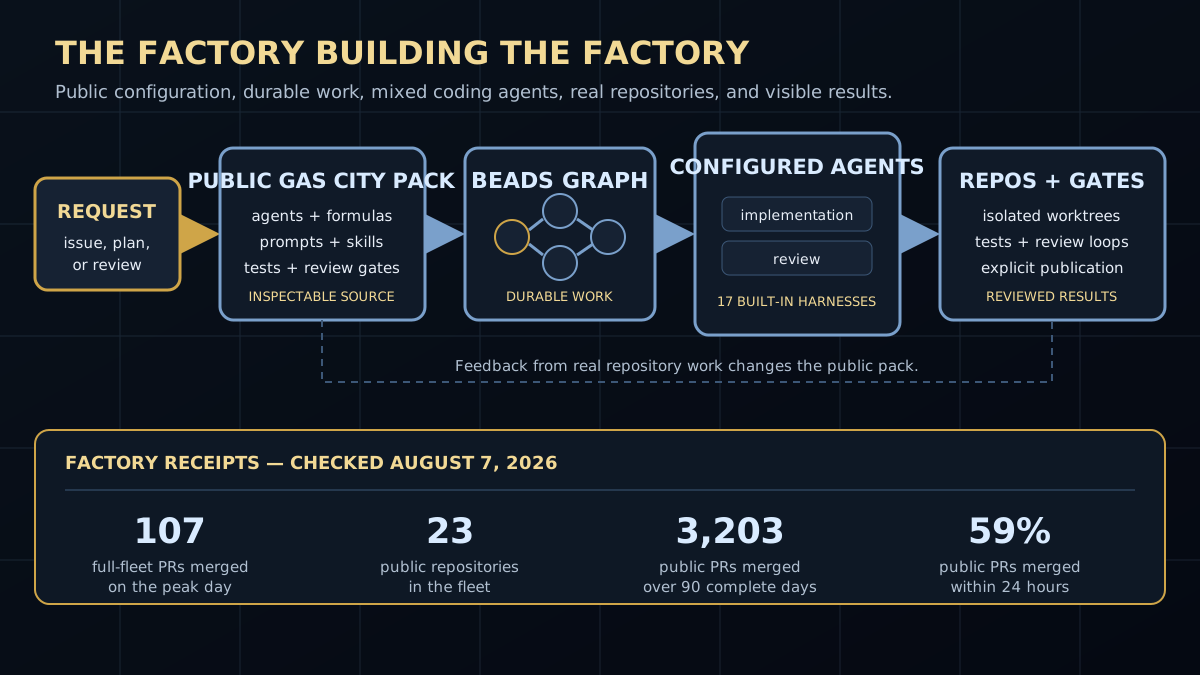
A software factory stops being an architecture diagram when it becomes the ordinary way real repositories get maintained. The Gas City team uses the public gascity pack to plan, implement, review, and publish work across 23 public repositories in the gastownhall GitHub organization, including Beads and Gas City.
The important parts are open for inspection: the live Maintainer City dashboard, the pack, its workflow formulas, the Gas City orchestrator, the Beads work graph, and the resulting GitHub activity. This is the factory building the factory.
The working method lives in a public pack
The public gascity pack defines the factory’s agent roles and formula workflows. The Gas City orchestrator runs that imported method without baking those roles into the binary.
The gascity pack is a substantial working method. Its current source includes full-lifecycle builds, workflows that begin from requirements, plans, decompositions, reviews, or existing work, plus design review, gap analysis, GitHub issue triage and repair, pull-request review, implementation, and review loops.
Those entry points share reusable planning, decomposition, implementation, review, repair, and publication machinery. Optional publication remains an explicit choice in the workflow. The same pack can therefore carry a small issue fix or a longer build without baking one project structure or coding-agent vendor into Gas City itself.
Because the pack is ordinary source, a team can read the prompts, follow the dependency graph, change a gate, replace an agent definition, and review the change in version control. The maintained packs guide explains how imports and composition work; the pack source shows what that model looks like under daily use.
One request becomes durable, reviewable work
Consider the public GitHub issue-fix workflow. It starts from an issue URL and turns that request into a dependency-aware method: capture the source, triage it, plan the change, decompose the implementation, execute ready work, review the result, apply review findings when needed, and optionally prepare the pull request.
Gas City materializes the method as beads. Each step has durable status and relationships outside the coding-agent chat that works on it. Ready steps can run through configured agents in isolated worktrees; blocked steps wait on the graph. Tests, review artifacts, and decisions remain attached to the work that produced them.
That separation is what makes the workflow recoverable. A CLI session can compact, exit, or be replaced while Beads still carries the request, completed steps, remaining blockers, and next action. The reference architecture maps the control and data boundaries in detail.
Watch Maintainer City operate
Gas City, Inc. calls the software factory that maintains its open-source projects Maintainer City. Its read-only public dashboard exposes the factory’s current operating view: active coding-agent sessions, queued and running work, formula-run progress, model calls and token rates, estimated cost, and the reporting status of supporting systems.
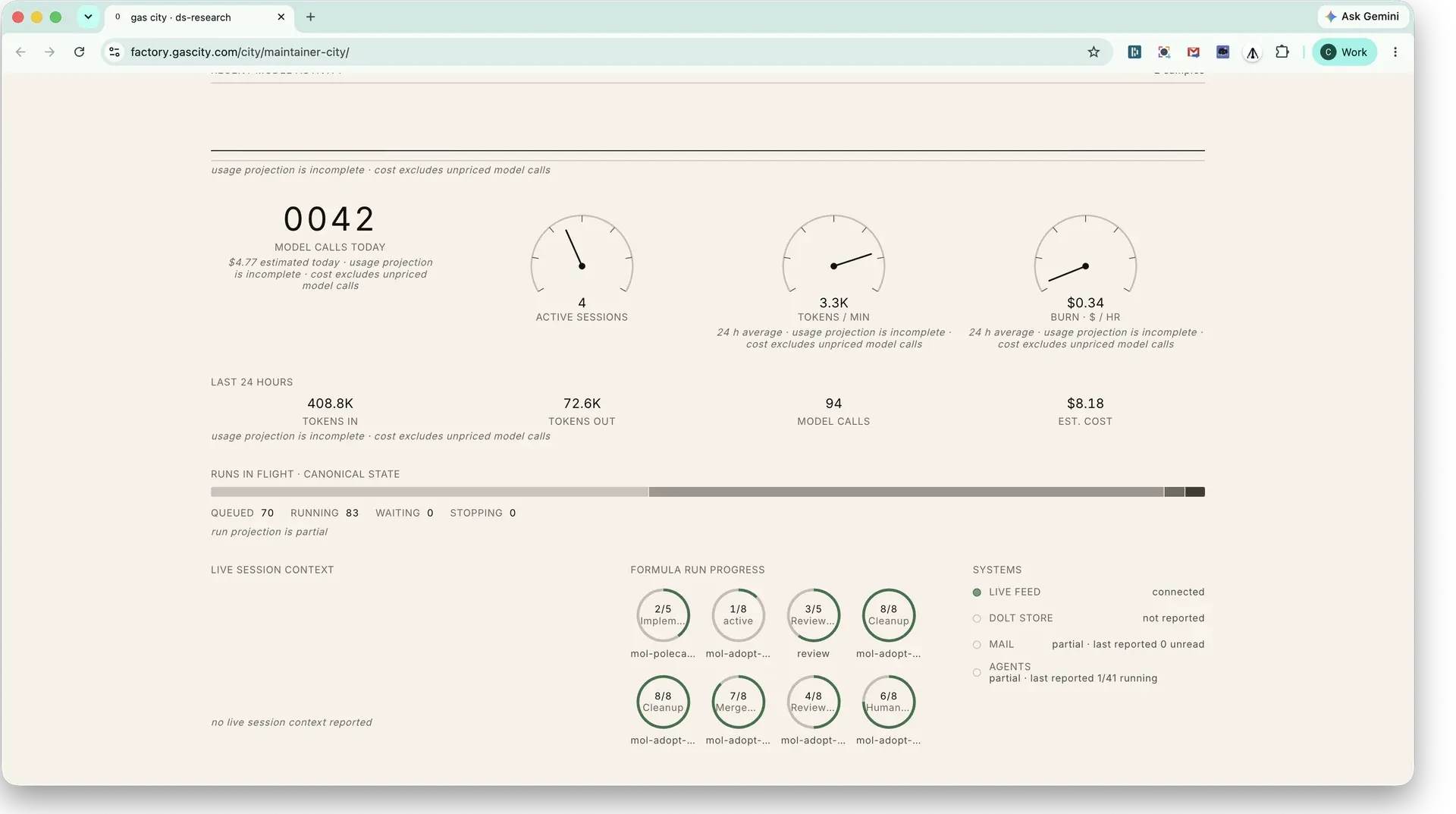
The screenshot was captured August 7, 2026; its counts change as the factory works. The dashboard also labels its usage and run projections as incomplete or partial and notes that estimated cost excludes unpriced model calls. Treat it as direct evidence that the factory is operating, not as a performance benchmark or complete accounting record.
The dashboard is the observation surface, not the factory definition. The public pack and formulas define the method, Gas City routes ready work, and Beads holds the durable work graph. The current page lets a reader see that machinery in motion without implying that every implementation detail or historical result is present in one screen.
GitHub activity shows public outcomes
The team’s full-fleet record shows a peak of 107 pull requests merged in one day. That is the useful headline scale measurement: completed merges across the fleet, not a per-repository average.
A reproducible public-only GitHub query, refreshed and live-verified August 7, 2026, found 102 human-authored pull requests merged on July 7 across 23 public repositories. The public-only receipt is five below the full-fleet record, so the Guide reports both rather than pretending they have identical scope. Across the 90 complete UTC days from May 9 through August 6, the same public dataset contained 3,203 merged pull requests; 59% merged within 24 hours, with a 13.2-hour median time to merge.
Read the peak as a capacity receipt, not a typical day or a controlled productivity result. Maintainer City answers what the factory is doing now. The GitHub record shows public repository outcomes over stated windows. Together with the public pack and work model, those surfaces make the system inspectable from method through operation to result, without claiming that every pull request was agent-produced.
The factory has clear seams
This factory is large enough to be useful and open enough to reshape.
Provider harnesses keep the work graph independent of the coding-agent CLI. Gas City had 17 built-in coding-agent integrations when checked on August 7, 2026, including Claude Code, Codex, Gemini CLI, Cursor, Copilot, OpenCode, and others. Custom commands extend the boundary beyond that catalog. The mixed-agent guide explains the routing details.
Packs make the operating method replaceable. The public Gas City Registry catalog listed 17 pack entries on August 7, 2026. Alongside the first-party factory were build methods based on BMAD, Compound Engineering, gstack, and Superpowers, plus GitHub, Discord, Slack, and runtime adapters. Every entry exposes inspectable configuration and a pinned source.
Formulas separate the workflow shape from the repos that run it. The same planning or review method can be imported across projects, while project scope, commands, prompts, gates, models, and agent harnesses remain customer choices.
Running the factory improves the factory
Using the public pack to maintain the projects beneath it creates a useful loop. A weak handoff, missing check, or awkward review path appears during real repository work. The team can change the pack, run the revised method, and publish the configuration for others to inspect.
That is a different kind of open-source artifact from a framework API or a polished demo. The reusable asset is the operating method itself. Community packs can explore other methods without forking the Gas City orchestrator, and teams can borrow one useful piece without adopting an entire prescribed organization.
The Gas City product and community map shows where the Registry, documentation, GitHub projects, and community discussion fit around the two open-source products.
Inspect the public record
| Question | Public surface |
|---|---|
| What factory method does the team run? | gascity pack source |
| How does the orchestrator execute it? | Gas City source and architecture docs |
| Where does durable work live? | Beads architecture |
| What is the factory doing now? | Maintainer City live dashboard |
| What public repository activity resulted? | Dated public-fleet query and Gas City project dashboard |
| What other factory methods and adapters are available? | Machine-readable Registry catalog |
Start from the working factory, then make it yours
Inspect the gascity pack before writing a factory from scratch. Choose the entry point closest to work your team already performs, run it against a real repository branch, and examine the resulting beads, artifacts, tests, review, and pull request.
Then change one meaningful part: a reviewer prompt, an agent harness, a blocking check, or the publication gate. Run the same kind of work again. Begin with the working, source-visible factory, then turn it into your own.
Related articles
- Build an AI software factory: Learn the category and the minimum structure that turns coding-agent sessions into a factory.
- Software factory reference architecture: Place packs, Beads, the orchestrator, coding agents, repositories, and observation in one system map.
- Use Claude Code, Codex, and Gemini together: See how one durable work graph remains independent of the selected coding-agent harness.
- Gas City scenarios: Explore the current local factory scenarios this machinery supports.